Is the NVIDIA Tesla M40 12GB Still Relevant for LLM Inference in 2025? by Elian Freyermuth
2025-06-07
·17 min read
It started while I was going to the grocery store. Phone in hand, half-paying attention to the sidewalk, scrolling eBay listings out of habit. Then I saw it: a Dell PowerEdge R720xd, dual Xeon, 32GB RAM, no drives — auction ending in 4 hours, current bid €80.
I bought it for €120. I told myself it was going to be my main self-hosting server. Nextcloud, Gitea, a few Docker containers — the usual homelab stack. Reasonable. Practical.
I was in AI engineering school at the time, deep into a specialty in ML, and the question of how to actually run and experiment with my own models at home was very much on my mind. Then I spotted a Tesla M40 12GB listed separately. €70. I thought about it for roughly one minute before buying it.
What I did not think about, not even for a second, was the noise.
The R720xd arrived with all its reasonable weight. I set it up on my main table — I had a one-room flat, so "the server room" and "the bedroom" and "the living room" were all the same room. I powered it on. The fans spun up. I'm not going to say it sounded like a jet engine because that's a cliché, but I will say my neighbor probably thought I was vacuuming my place for a very long time.
Running a model at night for time series analysis was a special experience. The thing would idle at a dull roar, and then the moment inference kicked in — fans at full blast, thermal management doing its thing — I was wide awake, fully alert.
I eventually moved away to another city and replaced it with something silent for my daily self-hosting needs. It stayed in my closet for a while since then. The R720xd and the M40 became dedicated to what they were always secretly meant for: running AI workloads. And that's exactly what I'm benchmarking today.
The question I want to answer properly, with real numbers: in June 2025, with modern LLMs, is the Tesla M40 12GB actually useful?
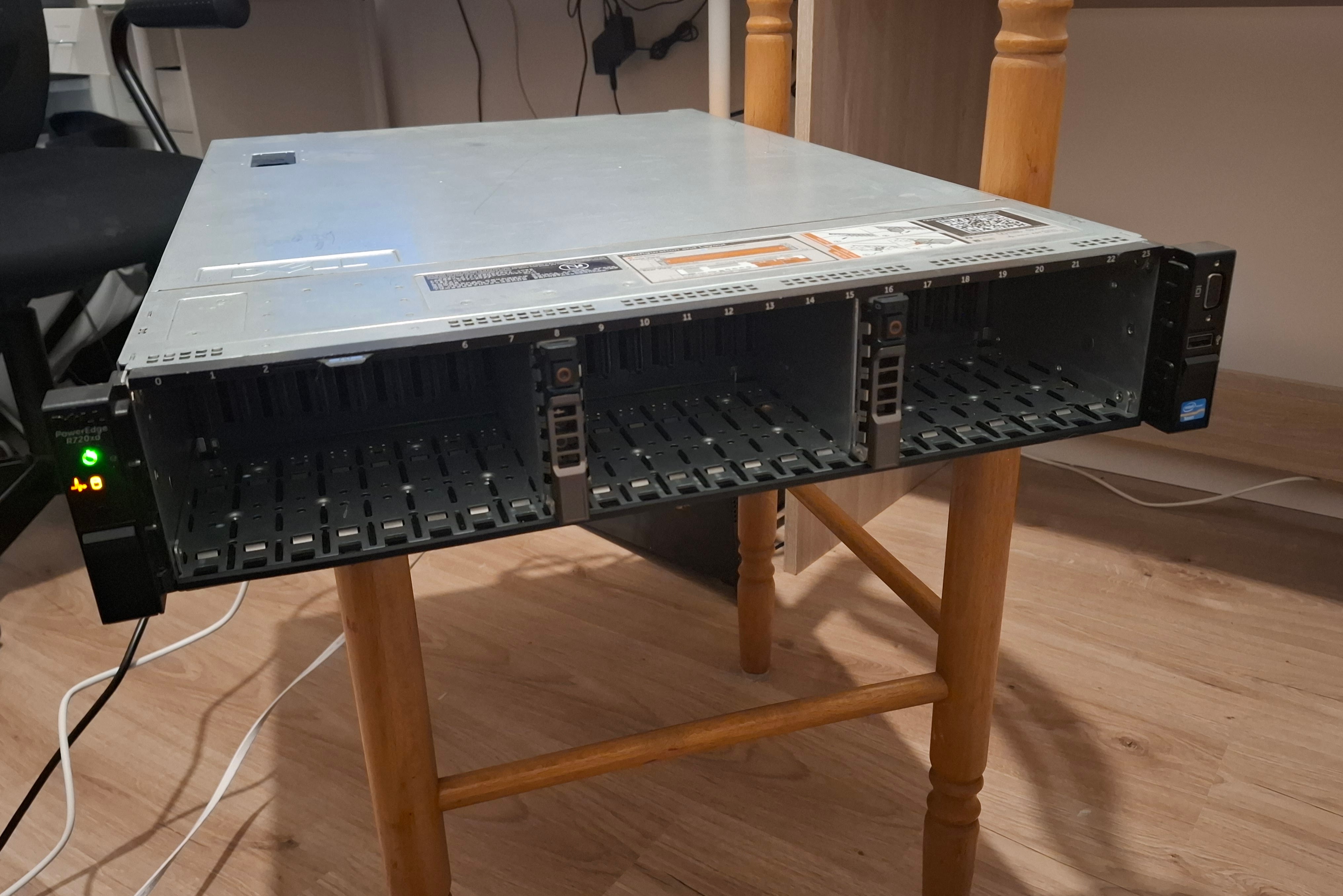
The Rig
Dell PowerEdge R720xd
The R720xd is a 2U rack server from Dell's twelfth generation lineup, released around 2012–2013. It's a machine built for one thing: running hard, for a long time, without complaint. Enterprise through and through.
| Component | Spec |
|---|---|
| CPU | 2× Intel Xeon E5-2680v2 (Ivy Bridge-EP) |
| Total cores | 20 physical cores / 40 threads |
| CPU clock | 2.8 GHz base / 3.6 GHz turbo |
| RAM | 32 GB DDR3 ECC |
| GPU | NVIDIA Tesla M40 12GB |
| Form factor | 2U rack, full-depth chassis |
| Cooling | Active server fans (very active) |
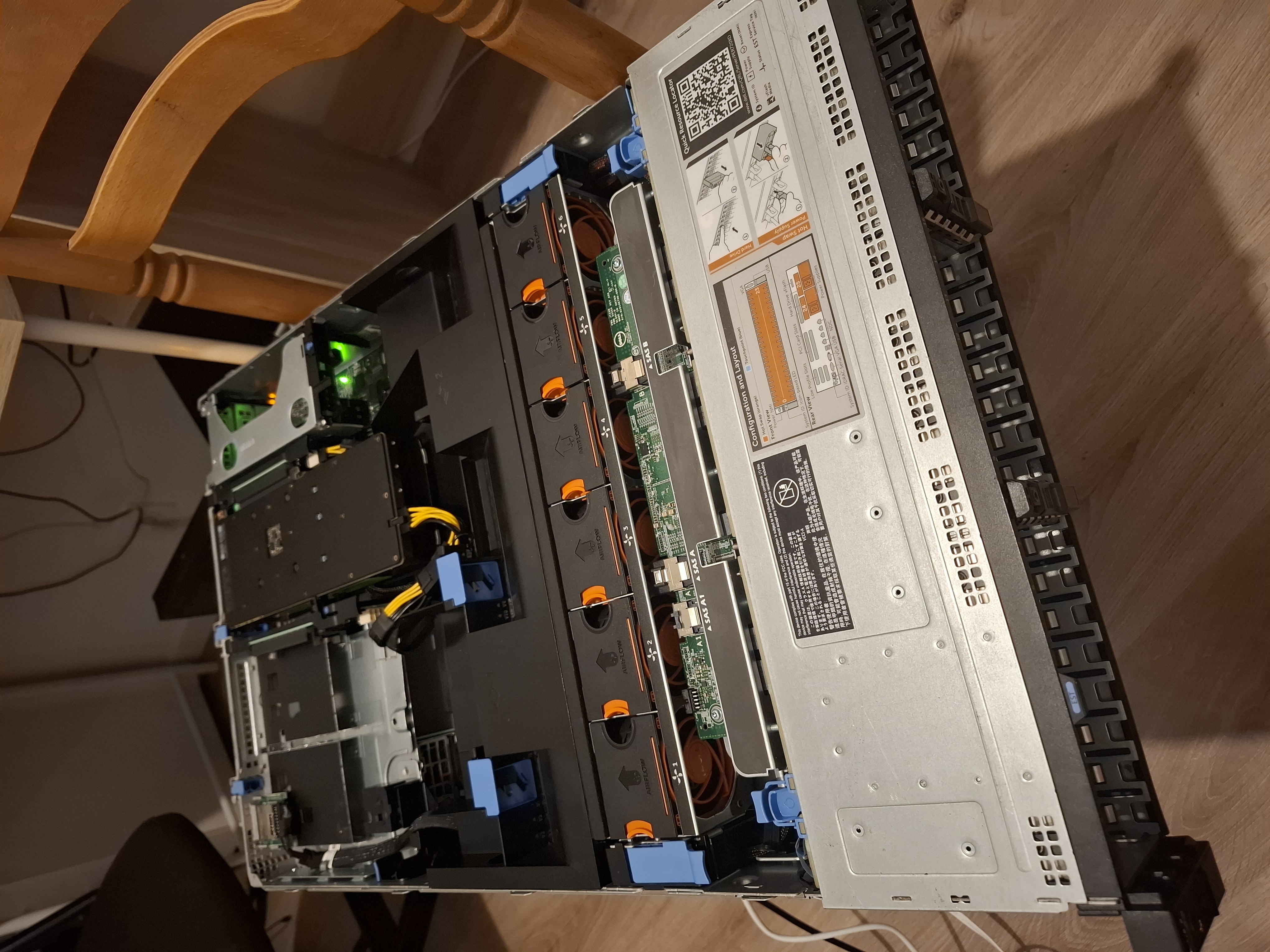
For inference workloads, the platform limitations — DDR3, older PCIe lanes, no NVMe — matter less than you'd think. Once the model weights are loaded into VRAM, the GPU runs mostly self-contained. The CPU and system RAM are largely bystanders.
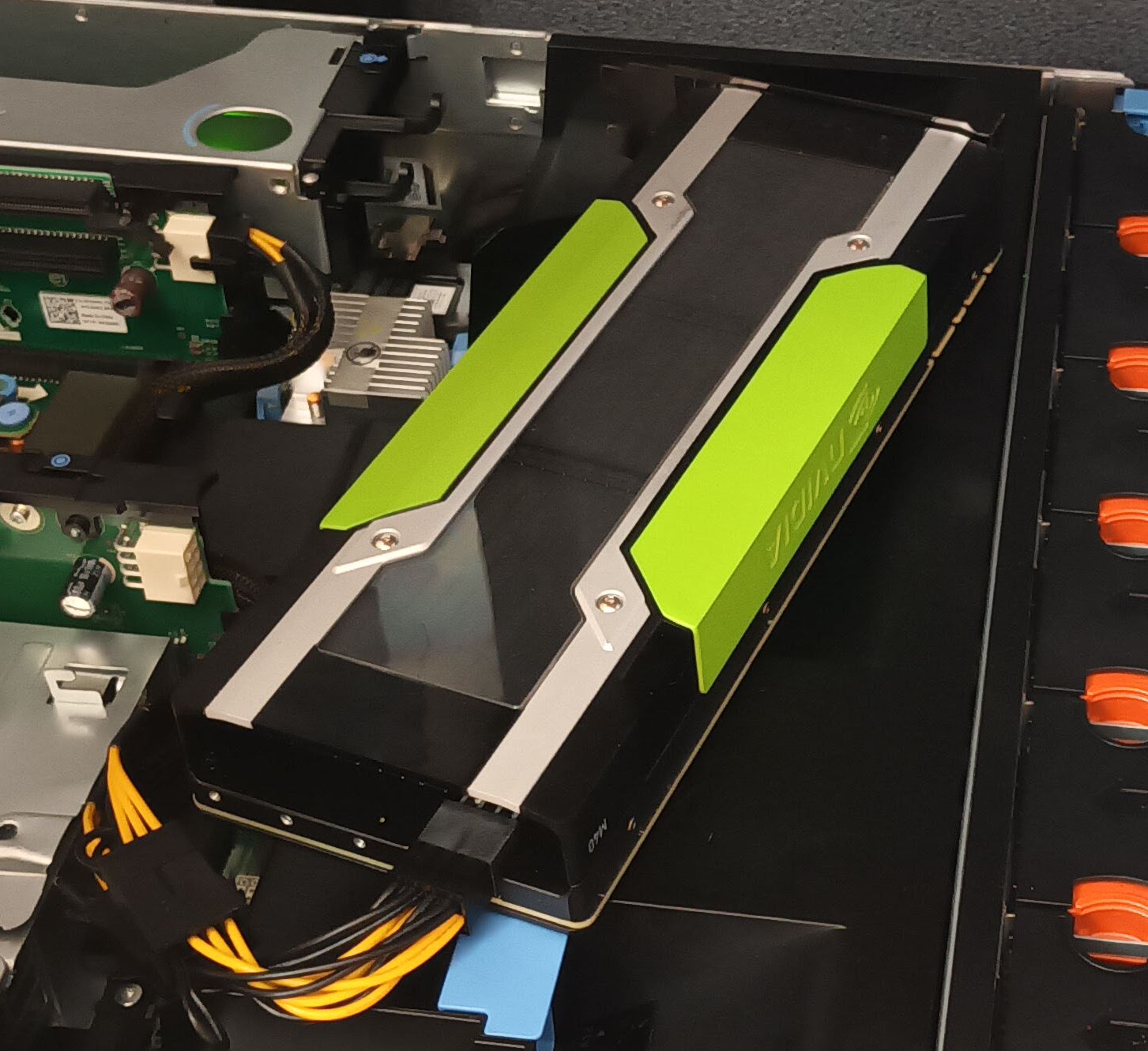
The Card
The Tesla M40 is built on NVIDIA's Maxwell architecture (GM200 chip) — same die as the GeForce GTX Titan X from 2015. It was designed to replace K40s and K80s in data center training clusters, back when training a ResNet-50 felt ambitious.
In 2025 it costs less than a dinner out.
| Spec | Value |
|---|---|
| Architecture | Maxwell (GM200) |
| CUDA Compute Capability | 5.2 |
| CUDA Cores | 3,072 |
| VRAM | 12 GB GDDR5 |
| Memory Bus | 384-bit |
| Memory Bandwidth | 288 GB/s |
| FP32 Performance | ~6.8 TFLOPS |
| FP16 Performance | ~6.8 TFLOPS (no native acceleration — falls back to FP32) |
| Tensor Cores | None |
| TDP | 250W |
| Release date | November 2015 |
Three numbers define the M40's fate for LLM inference in 2025:
- 12 GB VRAM — determines which models fit at which quantization level
- 288 GB/s memory bandwidth — the real bottleneck for autoregressive generation; this is 3× lower than an RTX 3090
- CUDA CC 5.2 — this is the painful one; most modern inference optimizations require CC 7.0+
The M40 has no Tensor Cores. That means no hardware-accelerated FP16, BF16, or INT8. Every transformer operation runs on CUDA cores at FP32 speed. No FlashAttention. No vLLM. No exllamav2. No AWQ. It's effectively cut off from the entire optimization ecosystem that makes modern GPU inference fast.
But it does have 12GB of VRAM. And in 2025, 12GB goes surprisingly far at Q4 quantization.
How I Ran the Tests
I wrote a custom Python benchmark script that manages everything automatically: spins up an Ollama Docker container with the correct GPU exposed, runs each model through a full suite of measurements, evicts the model from VRAM between benchmarks to prevent overlap, and dumps results to a timestamped JSON file.
Stack: Ollama 0.23.4 inside Docker (ollama/ollama:0.23.4), using llama.cpp as the inference backend. This is the most compatible setup for CC 5.2 hardware — llama.cpp still supports it, and Ollama wraps it cleanly.
Models tested — all released before June 2025, all running Q4_K_M quantization:
| Model | Released | Parameters | Why it's interesting |
|---|---|---|---|
mistral:7b | Sep 2023 | 7B | The OG local LLM baseline |
llama3.1:8b | Jul 2024 | 8B | Meta's 128k context flagship small model |
mistral-nemo:12b | Jul 2024 | 12B | Biggest model I could safely fit |
qwen2.5:7b | Sep 2024 | 7B | SOTA 7B at the time, trained on 18T tokens |
deepseek-r1:7b | Jan 2025 | 7B (reasoning distill) | Chain-of-thought reasoning at 7B |
phi4:14b | Dec 2024 | 14B | Pushing the VRAM limit on purpose |
For each model I measured:
- Cold load time: from first API call (model not in VRAM) to first token — true disk-to-VRAM load
- TTFT warm: time to first token with model already loaded (3 runs, averaged)
- Token/s: at 4 context lengths — 512, 2048, 4096, 8192 tokens — 3 runs each
- Peak VRAM: sampled via nvidia-smi every 500ms during inference
Power draw measurement wasn't available on this run — I hadn't installed powerstat on the server yet.
The Numbers
Cold Load & Time to First Token
Loading from disk into VRAM takes 9–14 seconds depending on model size, which is fine. Once the model is warm, time to first token is under half a second for all models — that's the number that actually matters for interactive use.
| Model | Cold load (s) | TTFT warm (avg, s) |
|---|---|---|
mistral:7b | 10.73 | 0.132 |
llama3.1:8b | 10.15 | 0.417 |
mistral-nemo:12b | 13.32 | 0.492 |
qwen2.5:7b | 12.52 | 0.790 |
deepseek-r1:7b | 9.23 | 0.445 |
phi4:14b | failed | — |
qwen2.5:7b has the highest warm TTFT at 0.79s — still perfectly usable, though slightly higher than the others. phi4:14b failed its cold load, which I'll get to.
Token/s — The Number That Matters
| Model | @ 512 | @ 2048 | @ 4096 | @ 8192 |
|---|---|---|---|---|
mistral:7b | 30.23 | 29.43 | 28.29 | 26.79 |
qwen2.5:7b | 28.92 | 28.65 | 27.47 | 26.00 |
deepseek-r1:7b | 28.17 | 27.44 | 25.49 | 16.72 |
llama3.1:8b | 27.96 | 27.54 | 26.70 | 25.26 |
mistral-nemo:12b | 24.78 | 24.14 | 23.34 | 21.30 |
phi4:14b | 16.22 | 15.74 | OOM | OOM |
mistral:7b, qwen2.5:7b, and llama3.1:8b all sit between 25 and 30 tok/s across the full context range. That's genuinely usable for interactive chat — not fast, but smooth enough that you're not watching a cursor blink anxiously. The M40's 288 GB/s bandwidth can keep these models fed without starving.
From 512 to 8192 tokens, mistral:7b drops only 3.4 tok/s (−11%). llama3.1:8b drops 2.7 tok/s (−10%). I expected worse from a GPU with no FlashAttention. The quadratic attention scaling is there, but at these model sizes it doesn't become brutal until you push well past 8K.
At 8192 tokens, DeepSeek-R1 crashes to 16.72 tok/s — a 41% drop from its 512-token baseline. At 4096 it already shows run-to-run variance (26.61, 25.48, 24.38 — a 2.2 tok/s spread across just 3 runs), which should have been the warning. DeepSeek-R1 generates extended chain-of-thought reasoning traces internally (<think>...</think> blocks) that consume context aggressively, and without FlashAttention the attention computation at that scale becomes genuinely expensive on the M40.
On that note — the quality samples for DeepSeek-R1 came back as empty strings across all three runs. That's not a bug. The model spent its entire 200-token generation budget thinking, and didn't get around to actually answering. Mood. In practice you need to budget 500–1000+ tokens for R1-style models to produce visible output.
phi4:14b is a partial result. At ~8.9 GB Q4, phi4 is flirting dangerously with the M40's 11.52 GB VRAM ceiling. It ran at 512 and 2048 tokens — 16.22 and 15.74 tok/s — which is slower than the 7B models but functional. At 4096 and 8192 tokens, the KV cache expansion pushed it over the edge: OOM, no result. The cold load failed entirely too. phi4:14b is technically possible on the M40 for short contexts only, and I wouldn't rely on it.
VRAM Usage
| Model | Peak VRAM (MB) | % of 11,520 MB |
|---|---|---|
qwen2.5:7b | 3,252 | 28.2% |
mistral:7b | 5,358 | 46.5% |
deepseek-r1:7b | 6,901 | 59.9% |
llama3.1:8b | 7,303 | 63.4% |
mistral-nemo:12b | 10,005 | 86.8% |
phi4:14b | — (OOM) | — |
qwen2.5:7b at 3,252 MB is striking — that's less than half the footprint of llama3.1:8b at the same parameter count. The reason is Grouped-Query Attention (GQA): Qwen 2.5 uses far fewer KV heads than standard multi-head attention, dramatically shrinking the KV cache. This also explains why it holds its speed well at 8192 tokens — it's simply using less memory per context token.
mistral-nemo:12b at 10,005 MB (86.8%) is the high-water mark for what I'd call "safely runnable" on this GPU. There's roughly 1.5 GB of headroom — enough for moderate contexts but tight at 8K.
Output Quality
Ollama 0.23.4 doesn't expose logprobs in a parseable way, so instead of perplexity scores I collected 3 freeform responses per model on a fixed technical prompt about transformer architecture. The outputs from all five functional models were coherent, technically accurate, and well-structured — correctly covering self-attention, positional encodings, and training objectives at a solid graduate level. Honestly, nothing surprising there. Q4_K_M at 7–12B just works; I've stopped expecting quality regressions from it.
How Bad Is It, Really?
Let's put the M40's numbers next to some reference points:
| GPU | Year | Mem BW | FP16 | Tensor Cores | Est. 7B tok/s |
|---|---|---|---|---|---|
| Tesla M40 | 2015 | 288 GB/s | FP32 fallback | No | ~28 |
| RTX 3060 12GB | 2021 | 360 GB/s | ~101 TFLOPS | Yes | ~55–65 |
| RTX 3080 10GB | 2020 | 760 GB/s | ~119 TFLOPS | Yes | ~80–100 |
| RTX 3090 | 2020 | 936 GB/s | ~142 TFLOPS | Yes | ~90–110 |
| RTX 4090 | 2022 | 1,008 GB/s | ~330 TFLOPS | Yes | ~150–180 |
The M40 at ~28 tok/s is roughly half the speed of a used RTX 3060 12GB — a card that costs €150–200 secondhand. The RTX 3060 has Tensor Cores, BF16, FlashAttention, full vLLM support, and more bandwidth. The M40's only advantage is the same VRAM at a fraction of the price.
Against an RTX 3090 it's about 3–4× slower. Against an A100 it's closer to 7–9×.
So yes, it's slow by modern standards. But 28 tok/s is still fast enough to have a real conversation with a model — you're not staring at a frozen screen. The question is whether €70 is worth that tradeoff.
The Software Wall
Software compatibility is the M40's real limitation in 2025 — more than the throughput numbers.
What works:
- llama.cpp with CUDA (CC 5.2 still supported)
- Ollama (wraps llama.cpp)
- GGUF models at Q4, Q5, Q8
- Context lengths up to 8192 tokens (with degradation)
- Basic Hugging Face
transformersinference (with caveats)
What doesn't work:
- FlashAttention — requires CC 7.0+
- vLLM — CC 7.0+ minimum, hard block
- exllamav2 — CC 6.0+ for basic, CC 7.0+ for full performance
- AWQ kernels — CC 7.5+ typically
- BF16 — no native support, silent FP32 fallback
- bitsandbytes / QLoRA — CC 7.5+ for full support
- Triton kernels — CC 7.0+ typically
The M40 is strictly a llama.cpp + Ollama card in 2025. That's a real constraint. If you want high-throughput serving, fine-tuning, or access to the modern inference optimization stack — this GPU isn't for you. But if your use case is "run a 7–12B model locally and chat with it", llama.cpp does that job just fine.
The Server: Worth Talking About
The R720xd is a genuinely great host for the M40 — this is literally what the card was designed to live in. Full-length PCIe 3.0 x16 slot, aggressive server airflow keeping the passive M40 thermally happy, ECC memory on both the system RAM and the GPU GDDR5. It's stable. It doesn't throttle. You can run inference for hours and the numbers don't drift.
The hardware was €190 total (€120 server + €70 GPU). Running cost is another matter — the R720xd draws 200–350W at load, and the M40 adds up to 250W, putting the system potentially above 600W under full inference load. At ~€0,20/kWh, sustained 24/7 operation would cost around €1,000–1,200 per year in electricity. That math only works if you're running it on-demand rather than as an always-on inference server.
For homelab use — spinning it up when you need it — the economics are completely reasonable. Under €200 for a full inference-capable server is hard to beat.
Verdict
Buy a Tesla M40 if:
- You find one under €60 and already have a compatible server chassis with proper airflow
- You're comfortable living in the llama.cpp / Ollama ecosystem
- You want to run 7–12B models locally for personal use
- You're a homelab person who enjoys the puzzle of making old hardware do new things
Don't buy a Tesla M40 if:
- You're starting from scratch with no server hardware — the total system cost changes the math
- You need vLLM, AWQ, QLoRA, or any modern inference optimization
- You want to run models larger than 12B
- You're comparing it to a used RTX 3090 at €300 — the 3090 wins on almost every dimension
Beyond pure inference, the M40's constraints compound quickly. Fine-tuning is effectively off the table — no BF16, no QLoRA, no bitsandbytes at CC 5.2. MoE architectures are similarly out of reach: even at aggressive quantization, the total weight across expert networks blows past 12GB for any model worth running. Multi-GPU scaling isn't a workaround either — the M40 has no NVLink, and PCIe-only tensor parallelism is too bandwidth-limited to be practical. Long-context RAG pipelines that stuff large retrieved documents into context hit the 8K+ degradation problem directly. And running a dedicated embedding model alongside your LLM simultaneously? Not enough VRAM headroom. There's also the form factor: the M40 is a passive card built for server chassis airflow and proprietary power connectors — it doesn't drop into a consumer build without the right infrastructure around it.
That said, there are use cases where the M40 is genuinely the right tool. Offline batch processing — generating summaries, annotations, or classifications over a fixed dataset overnight — is one of them. Speed doesn't matter, cost does. €70 is hard to argue with for that workload. Development and experimentation is another: prototyping RAG pipelines, evaluating prompts, iterating on agent workflows — you don't need 150 tok/s to test whether your retrieval strategy works. And single-user local inference is fine at 28 tok/s. The M40 doesn't fail at one person chatting with a model; it fails at concurrency, scale, and anything that requires the modern optimization stack.
The M40 in 2025 is a useful forcing function. Running inference on CC 5.2 hardware means you can't lean on FlashAttention to paper over quadratic attention complexity, can't use vLLM to hide latency behind continuous batching, can't reach for bitsandbytes when VRAM gets tight. You have to understand why those tools exist in order to work around not having them. And that understanding transfers directly to production decisions on real hardware.
The numbers here are honest: 25–30 tok/s on 7B models, 12GB of VRAM that runs mistral-nemo:12b at 86.8% capacity, a software wall that cuts off most of the modern optimization stack. That's the M40's profile in 2025. Constrained hardware. Working within those constraints is precisely what makes it interesting to benchmark.
Memory bandwidth dominates LLM inference throughput. VRAM capacity determines which models you can run. Compute capability gates which optimizations you can use. Those three variables explain almost everything in these results, and they're the same three variables that determine how any GPU performs at inference. The M40 just makes all three painfully obvious.
Appendix: Full Results
Token/s by model and context length
| Model | 512 | 2048 | 4096 | 8192 |
|---|---|---|---|---|
| mistral:7b | 30.23 | 29.43 | 28.29 | 26.79 |
| qwen2.5:7b | 28.92 | 28.65 | 27.47 | 26.00 |
| deepseek-r1:7b | 28.17 | 27.44 | 25.49 | 16.72 |
| llama3.1:8b | 27.96 | 27.54 | 26.70 | 25.26 |
| mistral-nemo:12b | 24.78 | 24.14 | 23.34 | 21.30 |
| phi4:14b | 16.22 | 15.74 | OOM | OOM |
Load times
| Model | Cold load (s) | TTFT warm (s) |
|---|---|---|
| mistral:7b | 10.73 | 0.132 |
| llama3.1:8b | 10.15 | 0.417 |
| mistral-nemo:12b | 13.32 | 0.492 |
| qwen2.5:7b | 12.52 | 0.790 |
| deepseek-r1:7b | 9.23 | 0.445 |
| phi4:14b | failed | — |
Peak VRAM
| Model | Peak VRAM (MB) | % of total |
|---|---|---|
| qwen2.5:7b | 3,252 | 28.2% |
| mistral:7b | 5,358 | 46.5% |
| deepseek-r1:7b | 6,901 | 59.9% |
| llama3.1:8b | 7,303 | 63.4% |
| mistral-nemo:12b | 10,005 | 86.8% |
| phi4:14b | — | — |
Test environment
| Parameter | Value |
|---|---|
| Server | Dell PowerEdge R720xd |
| CPU | 2× Intel Xeon E5-2680v2 (20c/40t) |
| RAM | 32 GB DDR3 ECC |
| GPU | NVIDIA Tesla M40 12GB |
| VRAM total | 11,520 MB |
| CUDA CC | 5.2 |
| NVIDIA driver | 580.159.03 |
| CUDA version | 13.0 |
| Inference stack | Ollama 0.23.4 (Docker) |
| Quantization | Q4_K_M (GGUF) |
| Runs per measurement | 3 |
Benchmark script available on request.